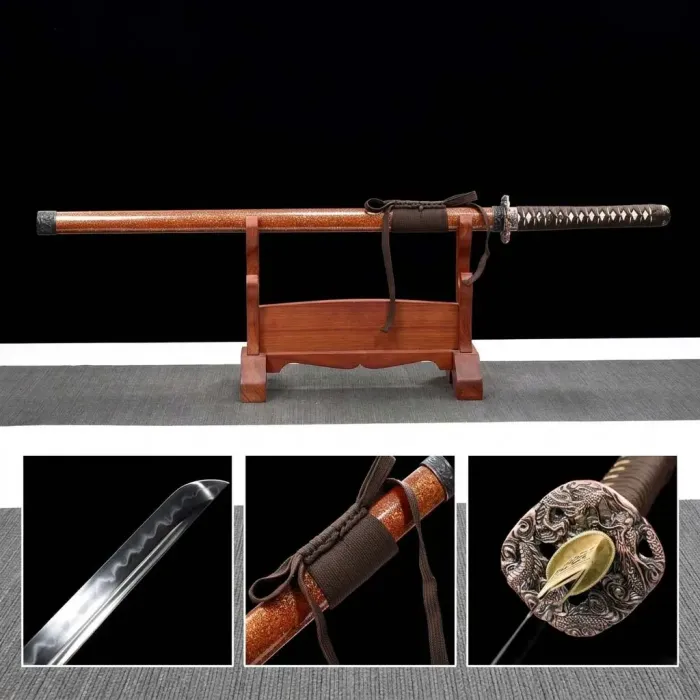
Each traditional Japanese sword exists as a remarkable work of art, but consider if you desire to reveal your exclusive design? Refining your tool is a fulfilling journey, allowing you to design a truly unique piece. From the hilt wrapping and habaki to the covering design and blade pattern, each constituent offers a chance for distinctive style. This review delves into the space of katana transformations, providing information for both starters and well-versed enthusiasts wanting to establish their mark on the traditional art of the samurai.
Freshman's Authentic Workmanship
For beginners wanting to embark on the gratifying journey of Japanese swordsmanship , 1060 steel katanas provide an prime entry point. This specialized grade of structural steel meets a ideal mix between low price and quality . While not quite as hard as superior-grade steels, 1060 provides a adequate level of edge development , making it ideal for starters to cultivate the preliminaries of sword maintenance and experience the elegance of handcrafted Japanese weaponry. It’s a excellent choice for establishing experience without the capital burden of more elite steels.
T Ten Alloy Sabers : Optimizing Excellence and Value
Satisfying specialists seeking an authentic cutting instrument experience without crossing the financial plan, T10 composition katanas represent a advantageous option. These implements offer a clear improvement in lastingness compared to basic alternatives, exhibiting sufficient edge retention and ample flexibility for elementary cleaving techniques. While not rivaling the premium characteristics of more refined steels like T100 or folded steel , T10 provides a effective blend of capacity and reasonableness , making them a trendy choice for novices and those on a tight income .
Going past the Sword : Personalizing Your Katana's Hardware and Hold
Considering the buffed steel is undeniably the focal point of a katana, truly enriching its elegance lies in the thoughtful customization of its fittings and grasp . This procedure allows enthusiasts to present their one-of-a-kind taste . Assess the extensive possibilities: menuki - decorative charms that introduce visual detail ; the hamon enclosures – often intricately molded ; the tsuka basis itself, wrapped in authentic ito binding ; and the fusa knob , which can be designed from various resources like gold or cartilage .
- Choose subjects that align with you.
- Evaluate with diverse composites .
- Focus on merit for a long-term result .
The Enchantment of the Katana: Past, Crafting, and Elements
This historical weapon possesses a exclusive allure, steeped in phases of the nation's history and folklore . More than merely a apparatus of combat , it's a mark of the samurai ethos – a fusion of mastery and command . Its unfolding spanned many generations, with early metallic weapons evolving into the slender curvature and lethal edge we identify today. The production involved is truly remarkable , requiring decades of mentoring to become skilled in . The process involves a multifaceted folding of steel bloom , creating layers that boost the steel’s flexibility and cutting ability. Various schools of metalworking started , each with their distinctive secrets and formulas for achieving the ideal equilibrium and edge - a truly strenuous pursuit.
- First Katana classes
- The importance of the traditional blade in samurai culture
- Traditional forging techniques
Picking the Appropriate Steel for Your Cutting Tool Project: 1060 vs. T10
Picking the proper steel is fundamentally important for any armament project, and the judgment between 1060 and T10 can be complicated. 1060 is a prevalent American compound, offering a fair balance of resilience and hardiness, rendering it somewhat easy to process. However, T10, a from Japan steel, usually boasts better wear resistance and can perhaps achieve a amplified end hardness, although it can be substantially complex to operate and requires exact heat tempering. Consider your skillset and targeted characteristics: for a newcomer, 1060 may be a prudent inception, while the competent smith might value the enhanced properties of T10.
- Ease of Operating
- Erosion
- Conclusive Strength
Realizing the Capability: Sophisticated Katana Tuning Practices
Perfecting the skill of sword modification extends far beyond basic whetting. Serious masters are now delving into advanced techniques to truly expose a blade's hidden potential. This features intricate work with the temper pattern, utilizing specialized compositions for differential strengthening and carefully choosing the design of the defense plate to optimize balance and performance. Beyond purely functional customizations, artisans are increasingly focused on attaining unparalleled aesthetic splendor, through complex imprinting and layered finishes that truly transform a katana into a fine art.
Building a 1060 Sword from Basic Metal to Beauty
The journey commences with plain 1060 iron , a solid material far distant the fine katana it will evolve . Accomplished bladesmiths use a detailed process of combining and forming the crude steel, repeatedly burning it and hammering it to discard impurities and fashion a even grain structure. This tiring process, often enduring for stretches , builds the important toughness and malleability characteristic of a true Japanese saber . Later heat processes , including exact hardening and setting , are critical to achieve the sought-after proportion custom katana of sharpness, durability and grace .- Combining: Diminishes impurities and creates grain structure.
- Molding: Molds the steel into the initial blade form.
- Hardening: Determines the final hardness and flexibility.
The Everlasting Fascination of the Katana: Broad Investigation of Metalcraft and Adjustment
The iconic katana persists a strong symbol standing for Japanese folklore, its allure far moving past mere arms . Forged from exclusive steel and periodically featuring intricate details , the system of creation itself is a sacred art. Beyond the fundamental craftsmanship, the ability to customize a katana - from the blade pattern to the handle wrapping and band - permits for a perfectly individual manifestation for both supporters and operators alike. This union of legacy steelwork and boundless personalization brings the katana's continued prestige across the terra .